The 21st Century ROAD to Housing Act: What Investors Need to Know

Head of Portfolio Acquisitions

The Essentials
- The 21st Century ROAD to Housing Act restricts large institutional investors, defined as for-profit entities with investment control of 350 or more single-family homes, from purchasing additional single-family homes beginning January 7, 2027, subject to several exceptions.
- Investors below the 350-home threshold aren't subject to the Act's purchase restrictions, but they'll feel its effects as institutional buyers become scarcer and as the window for selling a portfolio to one closes on January 7, 2029.
- After January 7, 2029, the buyer pool for ordinary rental portfolios will be limited to smaller investors, the retail market, and transactions that qualify for an exception, making it harder for investors to sell their portfolios.
The 21st Century ROAD to Housing Act, Explained
The 21st Century ROAD to Housing Act is a new federal law that restricts how many single-family homes the largest real estate investors can buy. The law generally applies only to entities that control 350 or more single-family homes, but it affects investors of every size by changing who is active in the market and on what timeline.
The Act became law on July 11, 2026, without the President's signature. The core of the statute is a purchase ban: starting on January 7, 2027, a large institutional investor, meaning an entity that controls 350 or more single-family homes, is restricted from buying additional ones. The restriction runs 15 years, sunsetting on January 7, 2042, and it doesn't require anyone to sell homes they already own. Large institutional investors will also face separate federal reporting requirements.
The ban has exceptions, mostly covering new construction and distressed property, plus one transitional exception that matters most to smaller owners. Until January 7, 2029, large institutional investors can still buy from sellers with fewer than 350 homes. After that date, that path closes.
Most landlords and investors own well under 350 homes, so the purchase restrictions don't apply to them directly. For these owners, the bigger issue will likely come when they sell: their buyer pool could change, particularly for those planning a portfolio sale rather than selling vacant homes one by one on the MLS.
Who Counts as a Large Institutional Investor
The law defines a large institutional investor as any for-profit entity, fund, corporation, partnership, LLC, joint venture, or association, engaged in investing in, owning, renting, or managing single-family homes, with direct or indirect investment control over 350 or more homes (not including any single-family home acquired as an excepted purchase under the statute after its date of enactment).
Two details in that definition are easy to miss.
First, the count aggregates. The statute counts homes controlled "alone or in concert with one or more other entities." Affiliated entities and joint ventures get counted together, so ten LLCs with 40 homes each under common ownership add up to 400, not ten separate counts of 40. Congress wrote the aggregation language specifically to close the entity-splitting workaround.
Second, the definition of a home is also broader than most people expect. A single-family home under the Act is any structure with two or fewer dwelling units, which brings duplexes within the definition. The treatment of duplexes under the 350-home calculation is an area where additional regulatory guidance could matter. Manufactured homes, by contrast, are excluded entirely. And "purchase" itself is defined broadly enough to sweep in mergers, acquisitions, new construction, foreclosures, and bulk purchases, not just a standard MLS transaction.
The Exceptions That Keep Institutional Capital Flowing
The Act narrows institutional investment in single-family housing rather than eliminating it. A set of exceptions lets large institutional investors keep purchasing certain types of properties through specific transactions:
- Build-to-rent homes: newly constructed properties retained as managed rentals
- Renovate-to-rent homes, where the improvements satisfy certain criteria and equal at least 15% of the purchase price
- New, renovated, or converted homes offered for sale rather than held as rentals
- Homeownership boost programs that, among other things, report rental payments positively to credit bureaus, provide tenants with the right to purchase the home if it is sold while the tenant is in place, and may include financial support such as price concessions
- Distressed acquisitions through foreclosure, deed-in-lieu, or satisfaction of a defaulted debt
- Newly built or converted homes in age-55-plus senior communities
- Purchases from other large institutional investors
The transitional window is a final exception that, unlike those listed above, doesn't last for the lifetime of the law. Under it, large institutional investors can still purchase from non-covered sellers, meaning anyone under the 350-home threshold, through January 7, 2029, without any other requirements. It’s the exception that could shape the market for small and mid-sized portfolio owners more than any other provision in the law.
That date is fixed to a federal calendar, not to market conditions, so it isn't likely to drift. Once it passes, a purchase that would have qualified under this exception no longer does, and an unqualified purchase carries the same significant civil penalties as any other violation of the Act.
How Buying and Selling Investment Properties Works Today
Most home transactions occur on listed marketplaces commonly referred to as the MLS, the shared listing system that buyers and real estate agents use to find homes. The MLS is often the most lucrative avenue for selling a move-in ready home because it opens the sale to the widest pool of retail buyers. Selling on the MLS is also usually slower, requires homes to be in market-ready condition, and necessitates full visibility and access to interested buyers.
In addition to selling on the MLS, off-market channels, such as working with cash buyers and specialty investors, also exist. These channels are most suited for those who want to sell a portfolio of occupied homes, since most buyers on the MLS are seeking to purchase a single home they can move into right away. If portfolio owners were to sell a batch of tenant-occupied homes on the MLS, they'd need to list one at a time and cover the resulting vacancy and carrying costs.
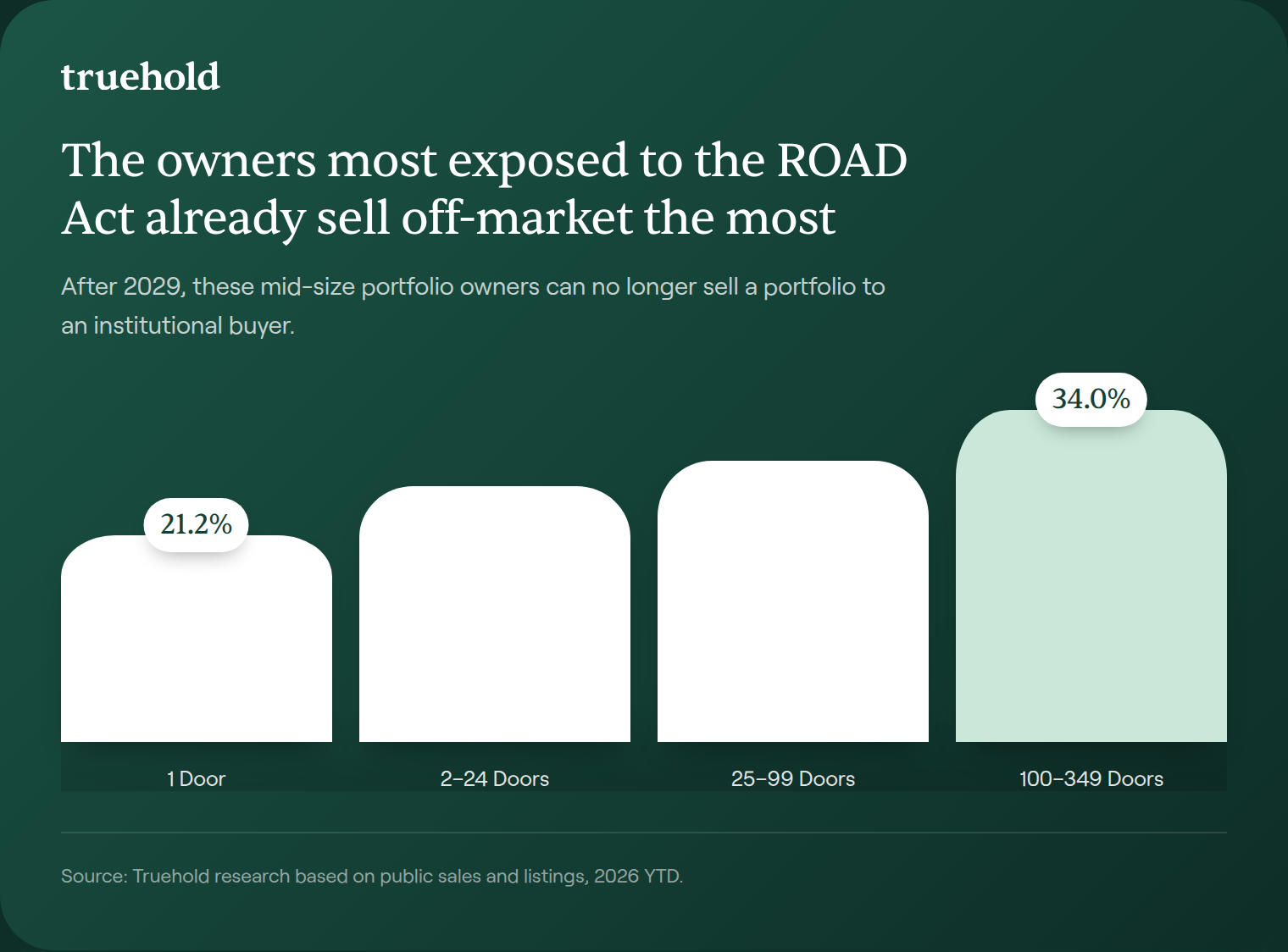
Owners turn to off-market channels more often as their portfolios grow. Single-property owners sold off-market about one in five times last year, according to public sales and listings records through mid-2026, while owners holding 100 to 349 properties, the bracket closest to the Act's institutional threshold, sold off-market roughly one in three times.
What This Could Mean for a 20-Home Portfolio
Take a landlord who owns 20 rental homes today and expects to sell the whole portfolio in three years, sometime in 2029. Under the current calendar, that sale lands right around when the transitional window closes. Depending on exactly when in 2029 that owner is ready to sell, a large share of the buyers who would have competed for that portfolio, the ones with the capital to close on 20 homes in a single transaction, may no longer be legally able to bid.
The owner still has a portfolio worth selling. Who's allowed to buy it in bulk changes, and a landlord who assumes today's buyer pool will still be there in three years is planning around a date that no longer applies to that buyer.
What Changes Once the Window Closes
Institutional demand for existing rentals doesn't disappear entirely after January 7, 2029. It narrows to the exceptions the law leaves open: build-to-rent, homes substantially renovated with improvements equal to at least 15% of the purchase price, and properties acquired through the mechanics outlined in the homeownership boost program. A large institutional investor can still buy a portfolio under one of those structures, but many occupied rental homes won’t fall within those protected exceptions.
A small landlord can still sell a portfolio after 2029, though the law may shrink the number of large institutional buyers legally able to purchase it in a single transaction.
As that buyer pool narrows, the realistic bulk-sale options for a small portfolio become other owners under the 350-home threshold or the retail market, where landlords can sell off one home at a time.
Deciding Whether to Hold or Sell
Whether to hold or sell is worth deciding deliberately. Nothing in the law forces an owner to sell. Holding for another year or another decade remains an option, but it’s worth confirming that the portfolio’s financing and operating economics actually support that plan.
Selling after the transition period may still be possible through buyers that are not covered by the Act, as well as through transactions that qualify for one of the Act's exceptions.
A few concrete steps make sense regardless of which way an owner leans, and starting them now, before there's any deadline pressure, means having answers ready whenever the decision needs to be made.
Getting Ready Before the Window Narrows
Counting the doors the way the statute counts them is the place to start. That means including duplexes and anything held through partnerships, joint ventures, and related entities when determining how the threshold applies. Anyone operating closer to the threshold should confirm how the aggregation and investment-control rules apply before assuming either way.
Rent rolls, signed leases, and capital expenditure records are worth pulling together next. These are the documents any buyer, institutional or not, asks for first, and gaps in them tend to get priced against the seller.
Existing loan terms are worth reviewing at the same time, not after a decision gets made. Financing taken out against multiple properties together is often structured around those homes staying occupied and producing income, so a plan that leans on selling homes one by one later is worth confirming against the actual loan terms first. It's also worth checking when that financing comes up for renewal. Debt locked in when rates were lower can look different if refinanced today, and that can move the real timeline up on its own.
What to Watch Next
Federal rulemaking and state legislation are both worth tracking as this law takes effect. Rulemaking, led by the Treasury alongside HUD, FHFA, and the SEC, could clarify how the law applies to complex ownership structures and other edge cases. State and local legislation matters too, since a federal template now on the books makes copycat bills at the state level a real possibility, and some states could set the threshold for a large institutional owner far lower than 350 homes. That's the development most likely to change the outlook for investors who assume this law doesn't apply to them.
A Plan for Whatever You Decide
The buyer pool for a bulk portfolio sale will only get narrower from here, which makes it worth having a plan.
Truehold buys rental portfolios directly, in a single transaction, eliminating the need for separate buyers and financing on each property, along with the carrying costs of selling one by one.
Get in touch with our team today by emailing partners@truehold.com to walk through your options and discuss next steps.
DISCLAIMER: NO RELIANCE. We hope you find the information in this blog informative and useful while also being aware of its limits. The blog and any guidance herein are made for informational purposes only and is not tax, investment, financial, legal, or other professional advice of any kind. Readers should not act upon the information in this blog or choose not to act based on the information without first seeking appropriate professional advice from your certified financial adviser, lawyer, and/or other trusted advisors regarding your individual circumstances.
Sources
- Mayer Brown. "Housing Legislation Banning Large Institutional Investors from Purchasing Single-Family Homes Becomes Law." https://www.mayerbrown.com/en/insights/publications/2026/07/housing-legislation-banning-large-institutional-investors-from-purchasing-single-family-homes-becomes-law
- Forbes. "Bill Restricting Institutional Investors From Buying Homes Passes Senate." https://www.forbes.com/sites/zacharyfolk/2026/06/22/senate-passes-housing-bill-restricting-institutional-investors-from-purchasing-homes/
- Goodwin. "Impact to Institutional Investment in the SFR Rental Market." https://www.goodwinlaw.com/en/insights/publications/2026/07/alerts-realestate-21st-century-road-to-housing-act-impact-institutional-investment-sfr-rental-market
- Congress.gov. "H.R. 6644, 21st Century ROAD to Housing Act, Sec. 1001(f)." https://www.congress.gov/bill/119th-congress/house-bill/6644/text
- Hunton. "The ROAD to Housing Act Leads Back to Build-to-Rent With No Divestment Requirement." https://www.hunton.com/insights/legal/the-road-to-housing-act-leads-back-to-build-to-rent-with-no-divestment-requirement
- National Law Review. "21st Century ROAD to Housing Act Becomes Law: Implications for Large Institutional Investors." https://natlawreview.com/article/21st-century-road-housing-act-becomes-law-implications-large-institutional
- CNN Business. "A new law limits mega-investor home purchases. Will that make homes cheaper?" https://www.cnn.com/2026/07/12/business/mega-investor-home-purchases-law
- Truehold. "2026 Sale Activity by Owner and MLS Data Analysis." Internal analysis of public sales and property records, 2026 YTD.
Frequently asked questions
The 21st Century ROAD to Housing Act is a federal law that restricts how many single-family homes the largest real estate investors can buy. It applies to large institutional investors, defined as for-profit entities with direct or indirect investment control of 350 or more single-family homes, and restricts them from purchasing additional single-family homes starting January 7, 2027, subject to several exceptions.

Head of Portfolio Acquisitions
Tyler Gibson is a real estate acquisitions professional with extensive experience sourcing, underwriting, negotiating, and executing single-family rental investments. He currently serves as Head of Portfolio Acquisitions at Truehold, where he leads transactions from initial sourcing and negotiation through closing. In addition to portfolio acquisitions, Tyler oversees the company’s off-market, one-off acquisition channel and works directly with investors and brokers across the country. Throughout his career, Tyler has personally transacted more than $1 billion in single-family rental investments, ranging from individual assets to large institutional portfolios. Outside of work, Tyler is a proud husband and father who enjoys spending time with his family, golfing, staying active, and cheering on the Nebraska Cornhuskers.